Filhos de Bimba Canada - Capoeira & Dance Classes
  • Home
  • About
  • Classes & Rates
  • Events
  • Blog
  • Contact

FdB Toronto December Newsletter:  A Retrospective of 2022

11/30/2022

0 Comments

 
Picture

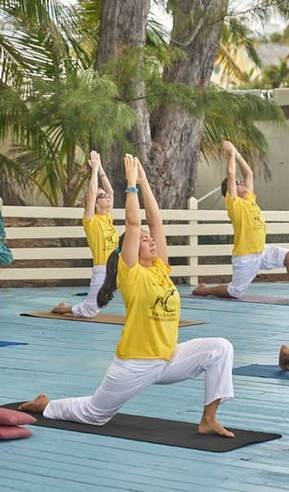
Professora Lang training for her Yoga Instructor Diploma - Sivananda Bahamas Ashram, January 2022


The year 2022 was a profoundly transformative one for me and for FdB Toronto, and it began under the auspices of yoga.  After struggling for many years to keep the school and my own capoeira practice going, yet feeling increasingly frustrated with the rising cost of rentals, and the challenges of creating a community in a fast-paced and vast city like Toronto, I knew that something was not working.  I needed to open myself up to other ways of being and doing, both in capoeira and in other aspects  of my life. 

In the ancient Vedic teachings, from which yoga springs, the Gods and Goddesses represent energetic and symbolic aspects of life and God - of ourselves.  Ganesha, the elephant-headed God, is the Remover of Obstacles (much like Ogun in the Afro-Brazilian religion, Candomble).  And what a whirlwind he created in my life, when I opened myself to his powerful energy!

After an extremely intense month at the Sivananda Ashram in the Bahamas (in the midst of a Covid resurgence), I became a yoga teacher.  My days there began at 4:15, when my neighbour's alarm would ring,  and would end somewhere between 10:30 and 11:00 pm.  Yoga practice, philosophy, history, and anatomy, karma yoga and a daily dip in the sea...  The days blended into one, yet I emerged somehow transformed, my body more supple, my energy purer than it had been in years.  I returned to Toronto with a fire in my belly and a desire to change my life profoundly.

Months later, I teach yoga in several places - at a community centre, at the Sivananda Centre, online.  My capoeira teaching has expanded too - at a student's house, a community centre, online, and soon, in a gym.  Yoga and capoeira - the yin and yang of my life - balance me and keep me afloat amidst the astronomical rise in the cost of living in Toronto.  Forced out of the shadows by necessity and thrust into the limelight, my life has changed. 

Despite my fears of criticism and rejection, the reception has been warm and overwhelmingly positive.  Teaching capoeira and/or yoga to children as young as 6 and to elders as young as 93 means that there is never a dull moment, and the learning curve is steep!  Yet, my world is expanding and my confidence with it.  Doors I had never dreamed of are beginning to open. I owe a lot of this to yoga, and of course, to my courage in confronting old fears buried in the darkest recesses of my heart and mind.

I don't know where the future lies.  I still live with work, housing and financial insecurity, but something inside me has changed.  For the first time in many years, there is a feeling of hope, an enthusiasm I had forgotten.  So for now, Toronto is home, and FdB Toronto is my family.

Thank you, to all my dear students, friends and family, for your encouragement, your love, and your helping hands.  Without you, I would not have me it this year.  May 2023 shine even brighter for us all!

Muito axe,
Professora Langi

May 2022 - The Capoeira House is Born

Picture
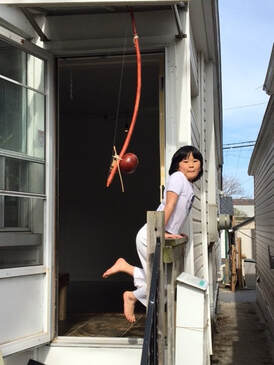
Beija Flor at the Capoeira House - Her home - May 2022

In May 2022, The Capoeira House opened! 

You can read more about this miraculous new chapter in my first blog, dated September of this year.  The idea was crazy, unorthodox, and potentially unworkable, but somehow it came together.  With the fantastic Lam family's generosity - Orquidea, Ariranha and Beija Flor - we began training in their living room once a week.  We still do... 

And every week, the energy that we cultivate there never ceases to amaze me.  Born of desperation, this wild experiment has proven to be full of beautiful surprises.  I want to thank the Lams with all my heart for opening their home to us.

June 2022: Bahia & Belem - Brazil

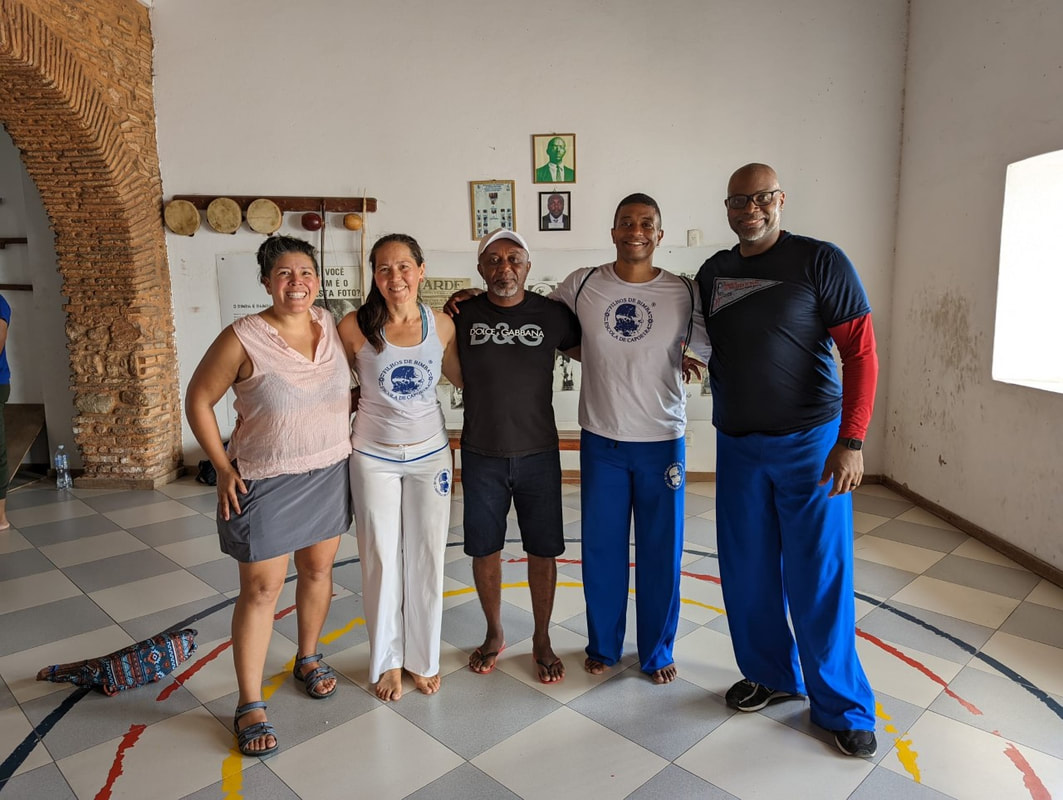
1. FdB North American Professores (Borboleta, Langi, Malandro and Trovoada) and Mestre Garrincha (in the middle) at the Forte da Capoeira, Salvador da Bahia - June 2022.
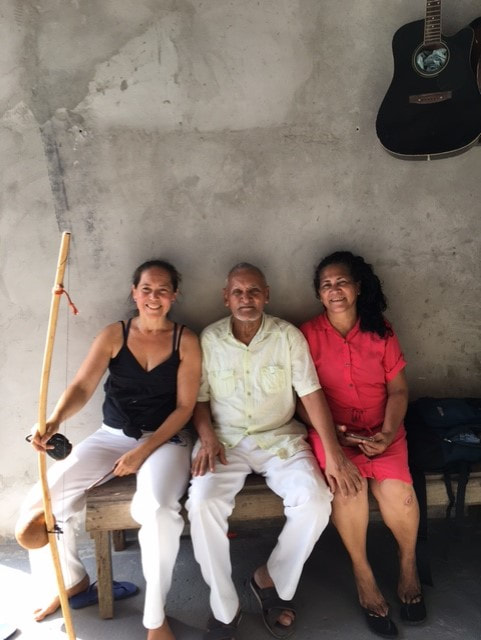
2. Visiting Mestre Bezerra and Marilene in their home - Belem do Para, June 2022.
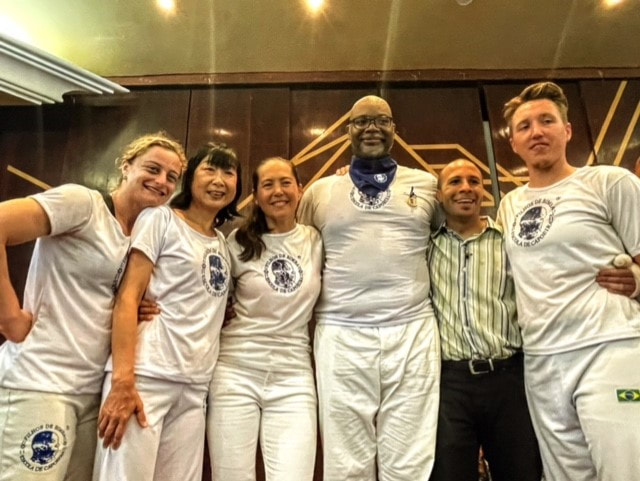
3. Professor Trovoada's Formatura with Prof. Lagartixa, Profa. Langi, Coruja, Pombinha and Massa - June 2022.
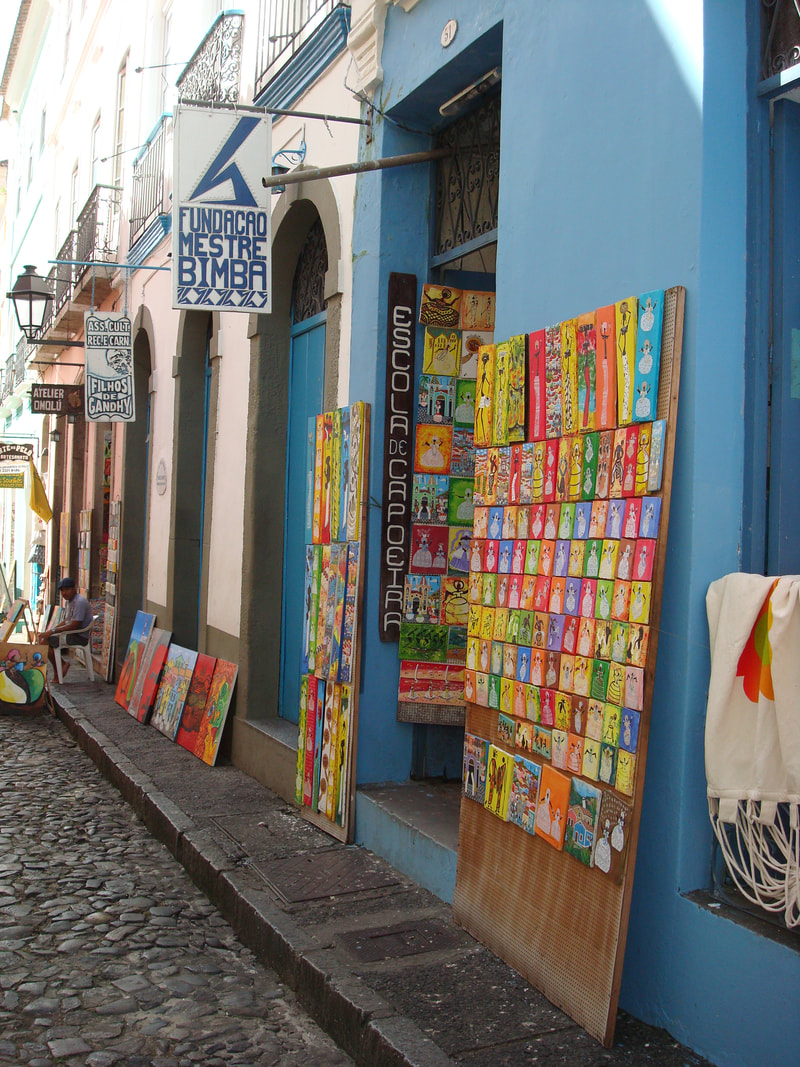
4. Fundacao Mestre Bimba - Our mother school in Salvador, Bahia. (Photo: Meredith Kenny)
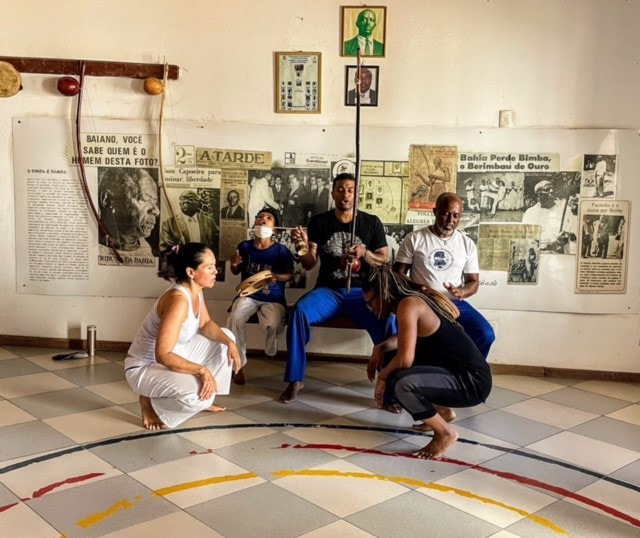
5. Class with Mestre Garrincha (seated right on pandeiro). Prof. Malandro is on berimbau.
6. Taking Mestre Santa Rosa to lunch at Alex do Carmo's restaurant in Santo Antonio, "Cade que Chama?".


Professor Trovoada's Formatura

Were it not for the immense honour of going to Bahia to become Professor Trovoada's madrinha (godmother) in capoeira, and to tie the blue scarf around his neck, I would  not have given myself the gift of a two-week trip to Bahia in 2022.  But this was a once-in-a-lifetime experience that I could not refuse.  My brother, Trovy, was finally being honoured for all his hard work and dedication.  The fact that Professor Lagartixa was coming, and that Massa and Pombinha would be in Bahia too, only added to the joy.  Amazingly, Professora Borboleta and Professor Malandro were also there with their students. 

The love and warmth of the students, teachers and Mestres of our school never ceases to surprise me.  Seeing Mestre Nenel, Mestra Preguica, Mestre Canguru, and Mestre Cafune, among others, as well as the many wonderful teachers in our school, is an incredible privilege.  Knowing that are roots are in Bahia, where capoeira was born, and that Capoeira Regional was created thanks to the vision of a man in our own lineage, Mestre Bimba, always makes me immensely grateful.  Feeling and witnessing the euphoria of a Roda in the Fundacao is an indescribable experience.

Then there was the unexpected side trip to Belem do Para, to see my former Mestre, Mestre Bezerra, and his family, made possible through the generosity of some of his former students who financed my domestic flight.  Mestre Bezerra struggles with Alzheimer's, so I wasn't sure that he would remember me, but to my relief, he did.  Not only was I able to personally hand him a copy of my thesis-book (in which he is interviewed), but we also played berimbau, sang, and played capoeira with his wife and children in their humble home.  I had not been back in 17 years, yet the love they showed me did not falter.  This moved me profoundly and taught me that life is full of surprises:  O mundo da muitas voltas.


Picture

November - Dandara/Zumbimba Festival


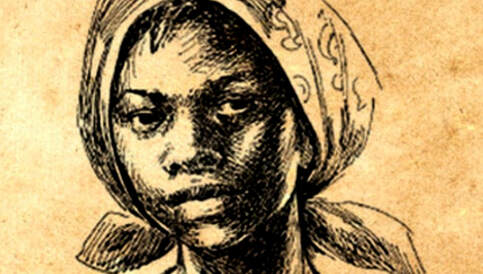
When I invited Professora Borboleta to speak to us about the history of Dandara and Zumbimba, I knew that we were in for a treat, however the richness and complexity of the vision she shared with us amazed us all. 

Her presence and that of Professor Malandro and his students made the event special, and inspired everyone to play their best in the Roda afterwards.  The talk reminded us that through the school, we are a part of something much greater than ourselves, and that it is a privilege to play capoeira, an art form rooted in suffering, but also in joy, courage and dignity.

Yet another successful event and celebration at the Capoeira House!

You can read more about the inspiration that gave rise to the event in my last blog post, dated November 2022.


Coming up in December...


This month, December 2022, we are excited to celebrate our annual Holiday Roda at Brown Community Centre (SW corner of St. Clair and Avenue Road), followed by a Brazilian/Japanese Dinner at Atlantico Sushi (St. Clair and Dufferin).

The Roda will involve the two childrens' classes that Professora Langi started teaching in the Fall Session.  It starts at 5:00 pm and ends at 6:30 pm.  We ask that you come 15 minutes early to make sure that the younger children are able to enjoy the event, since some of them may need to leave by 5:15.  If you are interested in attending, please RSVP!

A special thank you to Orquidea, Ariranha and Beija Flor for assisting me in these classes over the past two months!  I had my hands full and your presence brought a lot to these children...


Coming up in January...

I am excited to announce that in January of 2023, I will be adding a new class at Jimmy's Athletic (Bloor and Bathurst).  The class will run for 6 weeks starting on January 9, Mondays from 7:30-9 pm.   They will be a high energy workout, focusing on physical movement, strength and flexibility, and ending in a short Roda.  Registration will be done through the gym.  If there is enough enrolment, these classes will be ongoing. 

There will also be a children's class on Tuesdays from 4:30-5:15 pm, running for 6 weeks, starting January 10.  If you are interested, please contact the gym.


https://jimmysathletics.com/

I wish to thank Marki (Jet Li) for introducing me to the owner, Jimmy Kim, and for creating this amazing opportunity for me to expand classes.  Obrigada, Marki!  This is very exciting for FdB Toronto...

Please do read the wonderful piece below, written by our very own Deech (Marionete), in which she shares some of her experiences and revelations training capoeira and living in Brazil. 

Happy December and Happy Holidays, everyone!

Muito axe,
Profa. Langi


Picture

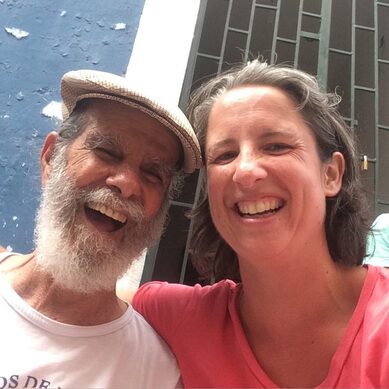
Mestre Cafune and Deech in the Fundacao Mestre Bimba


Jogo de Palavras

by Meredith Kenny ("Marionete")


Salvador, Bahia, Brazil (2006-2015)


“This all took place; let him who will believe. It took place in Bahia, where these and other acts of magic occur without startling anybody.”

Jorge Amado, 
Dona Flor and her Two Husbands (Dona Flor e Seus Dois Maridos)


I’m certain there is magic everywhere. In Bahia though, it bubbles and dances and skates at the surface like nowhere else. It’s difficult to help but feel the magic in Bahia, overwhelming at moments like drowning and at others you happily surf the waves. It is everywhere in the concentration of energy and movement and music and emotion, always combining and recombining in new alchemies that are as strongly Bahian as the dendê oil igniting your system after eating aracajé. Bahia has a full range of magic from dark and sinister to light and transformative, and among all of this the Bahians know how to play.  

To me, magic is an alchemy of connection and possibility, an improv on the fly as a way to see the world. Humour is magic and laughter is the proof that it is real. As is often the case, it was not until I found myself in situations where I could not joke with language, I discovered just how important humour is to my way of being and relating in the world. In looking back over several trips to Bahia, I can see just how important it is for me to be able to reach out and connect with a joke.

My relationship with Bahia began in the Spring of 2006 in Toronto when a friend of mine asked if I wanted to come with her to a capoeira class. “Sure!” I said, “... and, what’s capoeira?” I was introduced to the Brazilian martial art by Professora Lang, a Canadian who at the time was writing her PhD on capoeira, and who over the years has become one of my closest friends.  Lang was studying the roots of capoeira and the traditional forms that were born and are still practiced today in Salvador, Bahia. After only nine months of practicing the martial art that is played to the rhythms of the berimbau (a bow-like percussive instrument) and call-and-response songs sung in Portuguese, I decided to join Lang on a two week trip to Bahia with her and a small group of my fellow students. When I made that decision, I had no idea how much capoeira and Bahia would truly change my life, and at the same time set me even more clearly on the course it seems I have always been meant to take.  As Professor Muniz Sodré says in the film Mestre Bimba: A Capoeira Illuminada, “Capoeira teaches this lesson. To transform oneself to change. To transform oneself to remain as one is.”  

The Bahians we met that December were warm and welcoming as they opened their schools and homes to us.  We played capoeria, the only common language I had with the Bahians at that point, and enjoyed each other’s company over food and drinks and stumbling through conversations with some words in English, some palavras in Portuguese, and lots of confusion in between. There were often times in conversation I was talking to a Brazilian with what Portuguese I had and they were responding in their native Portuguese, but we were not actually talking about the same things. That didn’t really matter to any of us though, we were just happy to be having the conversation.

When I returned to Toronto, I was eager to learn as much as I could about capoeira, samba, the Portuguese language and Bahian culture. I continued to play capoeira, listen to all of the Brazilian music I could find, I studied Portuguese with a teacher, and started reading Brazilian literature. Jorge Amado is one of my favourites. In the beginning, I found his storytelling difficult because it is so different from what I knew. I soon grew to love his novels though, especially those that are set in Bahia, set in streets and neighbourhoods I have traveled. My first favourite Jorge Amado story was that of Dona Flor and Her Two Husbands.  The novel begins with the death of her young playboy husband Vadinho, during Carnival while dressed as a woman after a night of drinking and gambling. Dona Flor goes on to marry a doctor - Vadinho’s opposite - respected, stable, devoted. It does not take long in the story for Vadinho’s ghost to appear, and then begins Dona Flor’s life with her two husbands. To practice my Portuguese, after I read Dona Flor and Her Two Husbands in an English translation I tried to read it in its original Portuguese, Dona Flor e Seus Dois Maridos. That was slow going friends, muito devagar.  
    
Two years after my first adventure, Lang organized another two week trip to Bahia in March 2008 and without question I was in!  During this trip we reconnected with the Angola and Regional Mestres I met in 2006, and who were continuing to generously help guide and deepen our knowledge of the jogo (game) de capoeira and Bahian culture. There were many memorable moments during these two weeks - including a wedding! - but one afternoon in particular, on the beach of Ilha de Maré, I started to tap into my own magic in Bahia. 

After sailing on a tall ship to get to the island, blasting samba music and dancing the whole way, we settled in for a lunch of fresh seafood moqueca and cerveja on the beach. We Canadians were being hosted by Mestre Augusto and Mestre Santa Rosa - capoeira Angola mestres, musicians, poets and native sons of Bahia. I convinced Lang to translate a joke for me so I could share it with the Mestres:  

Meredith: “So, there was a doctor who lived in a small town…”
Lang: “Era um doctor bem respeitado em uma pequena cidade …”

When I started to tell this joke, I knew it was not a short one. It’s the kind of joke you embellish, add details, and generally build up for the groaner of a punchline that has questionable payoff. It was the only joke I could think of at the time though, so I went for it. 

Meredith: “... The doctor started to question the romantic feelings he was developing for one of his patients …”
Lang: “...Ele comonçeu a questionar os sentimentos românticos que estava desenvolvendo para um de seus pacientes …”

Beyond the gestures and translations we used to tell this epic joke, simply the act of the two of us telling a joke back and forth in two languages was ridiculous and funny to everyone sitting around the table. There were reactions and pauses throughout depending on which language was being spoken. And then the payoff:  

Meredith: “... Yeah, but you’re a vet.”
Lang: “... Sim, mas você é um veterinário.”

I told you, questionable. It was not the most elegant joke, not the most nimble use of language, but damn I was excited! For the first time, I had shared a joke with my Brazilian friends. In that moment, even though I needed to enlist Lang’s help in translation, I felt a little more truly myself in this foreign language and culture I was just getting to know.  

After this trip in 2008, I decided I needed to spend more than two weeks there. I had a giant crush on Bahia, and I needed to see if it was really love. When Lang returned from this trip, she made the decision to formally become a teacher of Mestre Nenel’s school, Filhos de Bimba. This was the school where I felt I belonged too, and I was eager to focus on practicing the capoeira Regional methodology and philosophy that Mestre Nenel’s father created. In Toronto, I worked and saved while I continued to play capoeira and generally be a part of the Brazilian community of events and music. My understanding of Portuguese was growing with what I was reading and listening to, but I did not often speak Portuguese outside of my class or brief conversations at events. Spending more time in Bahia would definitely help me become more fluent. After two years and the end of my contract at the time, I set off in May of 2010 for four and a half months in Bahia.  

I lived in an old house overlooking the Bay of All Saints (Baia de Todos os Santos), a fifteen minute walk from my capoeira school where Mestre Nenel welcomed me not only for official classes, but to hang out. I learned about building instruments, helped around the space, and got to know the Bahians and other foreigners who frequently dropped in too. I could speak in simple sentences and could generally keep up with conversations if I concentrated really hard, but when directly asked a question it would take me a few seconds to fully decipher what was being asked, then form an answer. This does not allow for quick wit and joking around, I was just trying to keep up!

Often between classes, Mestre Nenel’s son played a video game that had a vivid soundtrack, including several catchphrases that were all in English. Mestre Nenel is not fluent, but he does speak some English and would ask me about words and how to pronounce them. He started saying the catchphrases from his son’s video game, and confirmed the words with me. These catchphrases became our joke with one another, our favourite being, “Getting serious.” To this day, getting serious is how we greet each other and sign our emails. Whether in the school or out in the city, when we saw each other we would say these catch phrases, playfully building them up trying to beat each other to:

Mestre Nenel: “Getting serious.”
Meredith: “Stepping it up.”
Mestre Nenel: “Don’t blink.”
Mestre Nenel and Meredith: “You’re finished!!!”

Two months into that trip in 2010, I met Lang at the airport. She was there to prepare for her Formatura, the ceremony in our school where teachers officially graduate, and was staying in the same house I was overlooking the bay.  After two months on my own in Bahia, speaking for the most part only in Portuguese, I was so happy to talk with Lang when she arrived. I could not stop the jokes or the puns from flying! It seemed that holding the jokes in for two months was like holding in a sneeze: when given the opportunity to speak in my native language, the jokes spewed unbound into the night.  

By the end of this trip, though I was far from fluent, a cool thing started to happen when I realized I was no longer translating so much in my mind. I was thinking in Portuguese. My first two weeks back in Toronto, it surprised me that my instinct was to speak in Portuguese and that everyone around me was speaking English. The months I spent in the language and the culture also answered my original question: it was not a crush, a part of my heart will always live in Bahia. Once and awhile when I am walking in Toronto, for a brief moment I feel like I am there. I didn't know when, but I was sure I would find a way back. 

My most recent trip to Bahia was a two week visit in September 2015. I stayed in an old house turned hostel in the same neighbourhood that is a fifteen minute walk to Mestre Nenel’s school.  I arrived late on a Friday night and was very hungry for dinner. I dropped off my bag and wandered into the neighbourhood to a little restaurant I remembered. Within ten minutes I ran into a Bahian friend who lives in the neighbourhood and we sat at an outdoor table catching up. Ah, how I had missed the energy of Bahia!

The next morning I arrived early for the weekly roda (capoeira circle), and when I entered the school for the first time in five years, I was greeted by Mestre Nenel, “Getting serious!” Over these two weeks, I reconnected with old friends - including two of Mestre Nenel’s father’s original students, Mestres Boinha and Cafuné - and met new people who were now training at the school. Flor, a young woman who lived nearby, was in classes often too and we had the opportunity to train and play together many times.  

Capoeira is very social and often when a class ends, we all stick around and hang out for a while. After a class, Mestre Boinha and Mestre Cafuné were sitting on a bench. Flor went over and sat down between the two. They were all smiles and I had my camera out, so I started to line up a shot of the three of them. 

Mestre Boinha joked: “Oh, Dona Flor! rsrsrs (hahaha)” 
And Mestre Cafuné: “E seus dois maridos! KKKKKK! (And her two husbands! HAHAHA!)”

I lowered my camera, looked to Mestre Boinha then Mestre Cafuné, and asked: “Quem é Vadinho?!! (Who is Vadinho?!!)”

All: “KKKKKK! (HAHAHA!)”
Mestres Boinha and Cafuné: “Ele é Vadinho! Não, é ele! (He’s Vadinho! No, it’s him!)”

I had done it and I didn’t even see it coming! After many visits and time spent with these people and culture I love, a joke. An alchemy of connection and possibility, an improv on the fly. 

Magic.   


Picture

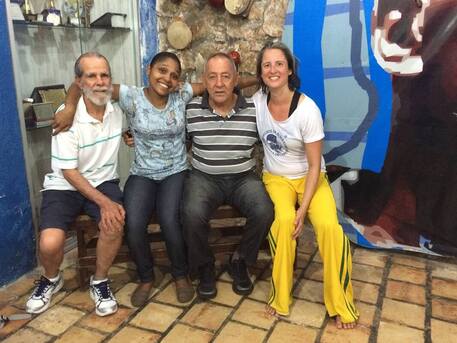
Mestre Cafune, Flor, Mestre Boinha and Marionete (Deech) in the Fundacao - 2010

0 Comments


Leave a Reply.

Proudly powered by Weebly
  • Home
  • About
  • Classes & Rates
  • Events
  • Blog
  • Contact